
Kennedy Krieger
End of Year Campaign
Kennedy Krieger had powerful patient stories and no framework to deploy them. I developed five campaign pillars, structured a full send calendar, and rebuilt the storytelling approach across email and direct mail — turning a single-note program into a multi-channel fundraising engine. Revenue up 44%.
They had the material.
They needed someone to hone
the strategy and make it sing.
Kennedy Krieger had been doing something right for years — their patient stories were genuinely moving. But the program wasn't targeted. The fundamentals were missing. The craft needed work.
Asks were buried in dense paragraphs. There was no match strategy, no send cadence with escalating urgency, no segmentation between active donors, lapsed donors, patients, and the midlevel donors who are typically the highest-value audience. The P.S. — one of the first places readers' eyes go with lots of conversion power — was an afterthought. The goal was invisible. Good instincts. No infrastructure.
- Strong patient stories — but long, unedited, and doing all the work alone
- Asks buried deep in dense paragraphs, easy to miss entirely
- No matching gift urgency — mentioned once, not built into the campaign
- No goal communicated to the donor
- P.S. line — prime reader real estate — left as an afterthought
- One audience, one voice, one send cadence for everyone
- No midlevel donor track despite high-value audience sitting untapped
- Stories cut to their emotional core — a short hook followed by 1-2 laser-focused story paragraphs, then the ask
- 4-5 asks per piece, urgent and impossible to miss
- Match deadline woven into every touchpoint as the campaign's engine
- Clear dollar goal visible throughout — donors knew exactly what they were building toward
- P.S. line weaponized — the last thing they read, the strongest ask
- Segmented by active donors, lapsed donors, patient families, and midlevel donors
- New midlevel track built from scratch — targeted materials for highest-value audience
Build the architecture first.
Then make every word count.
Before touching copy, I worked with the account team to build a full campaign calendar — multiple yearly initiatives, each with a defined purpose, send cadence, and audience segmentation. Every email had a specific job. No send was filler.
Then inside that structure, I rewrote the storytelling approach from the ground up.
"16% of donors to the campaign were net-new from the patient and family audience — an audience that had never given before."
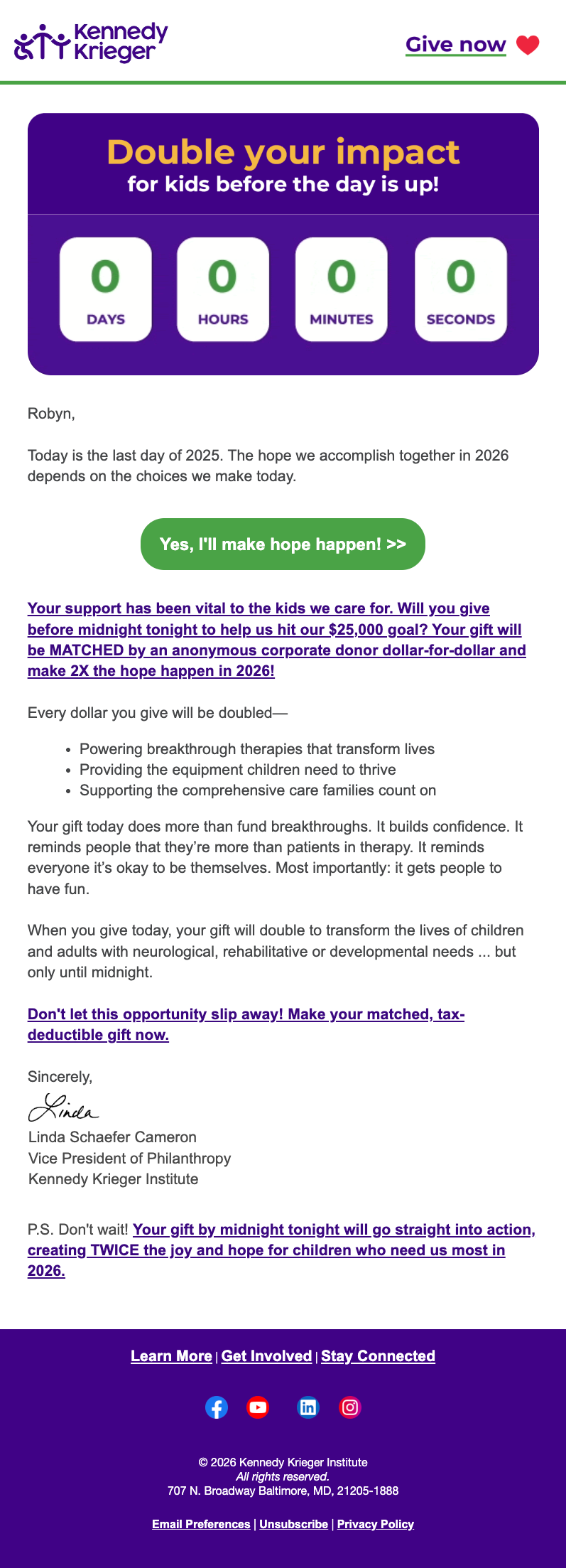
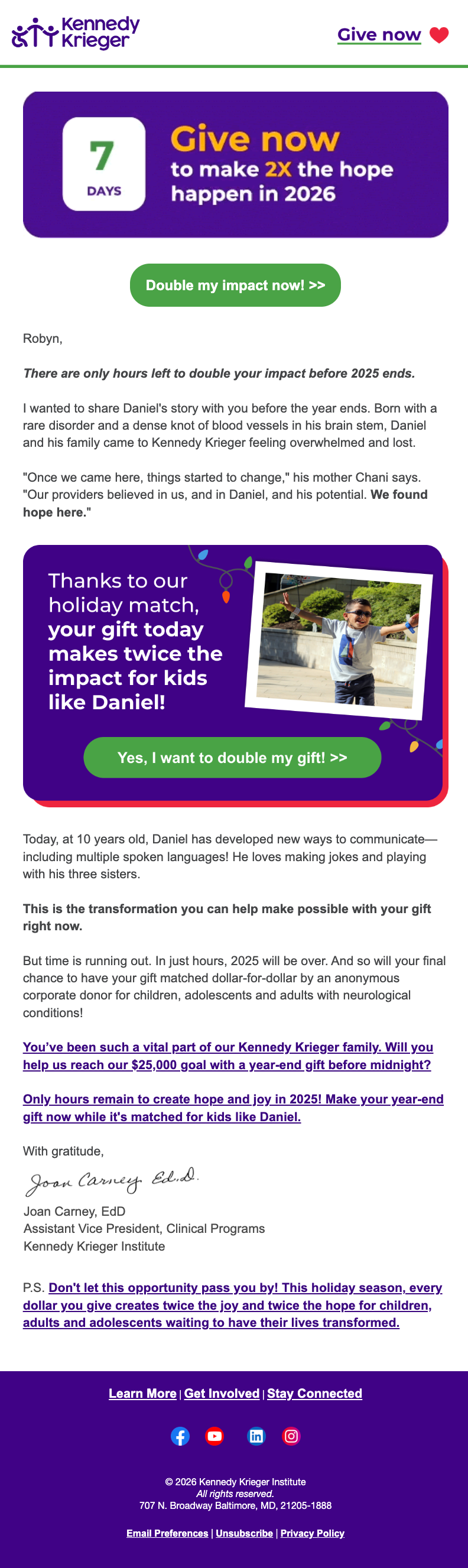
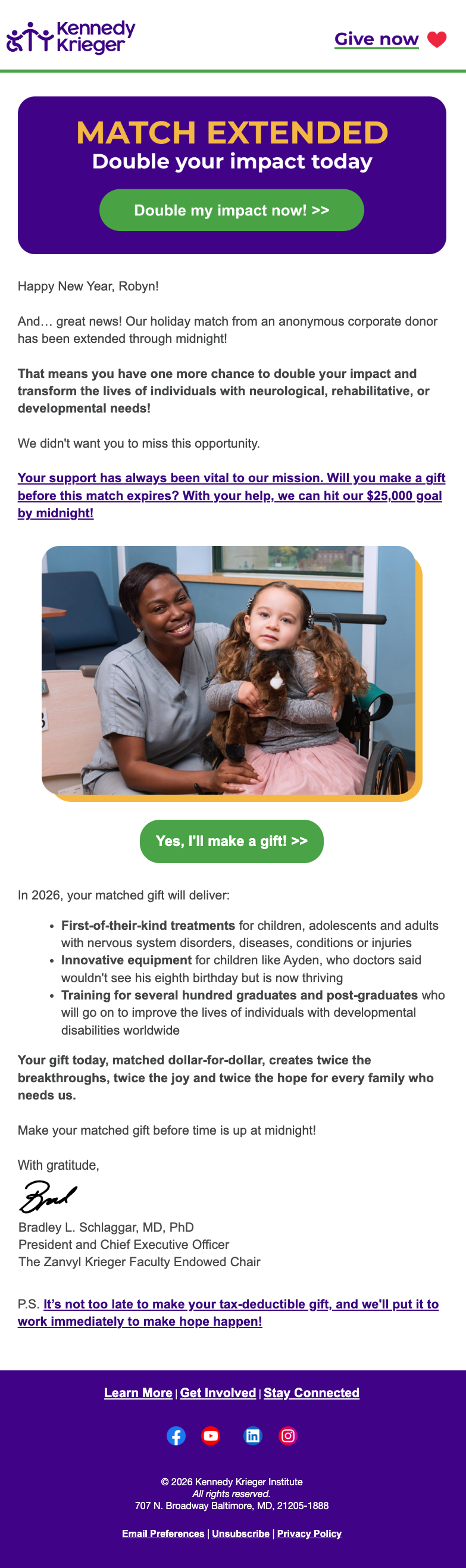
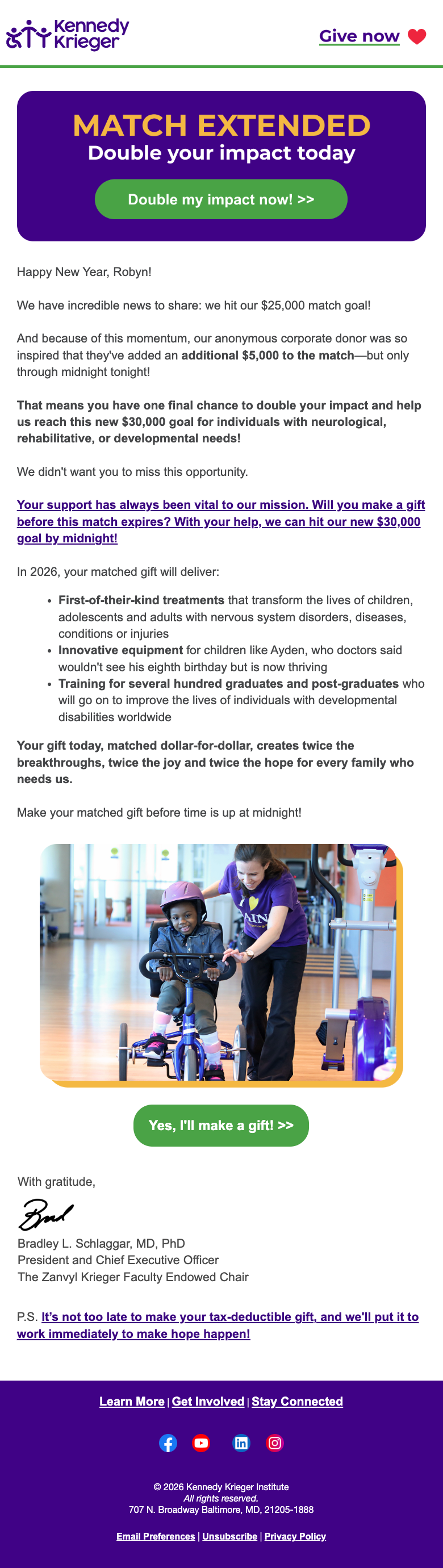
A 7-email arc built
around a single idea: joy.
Each email in the series featured a different Kennedy Krieger patient. Same campaign, different child, different story — but a consistent emotional logic. Joy as a force of hope. The matching gift as a way to multiply it.
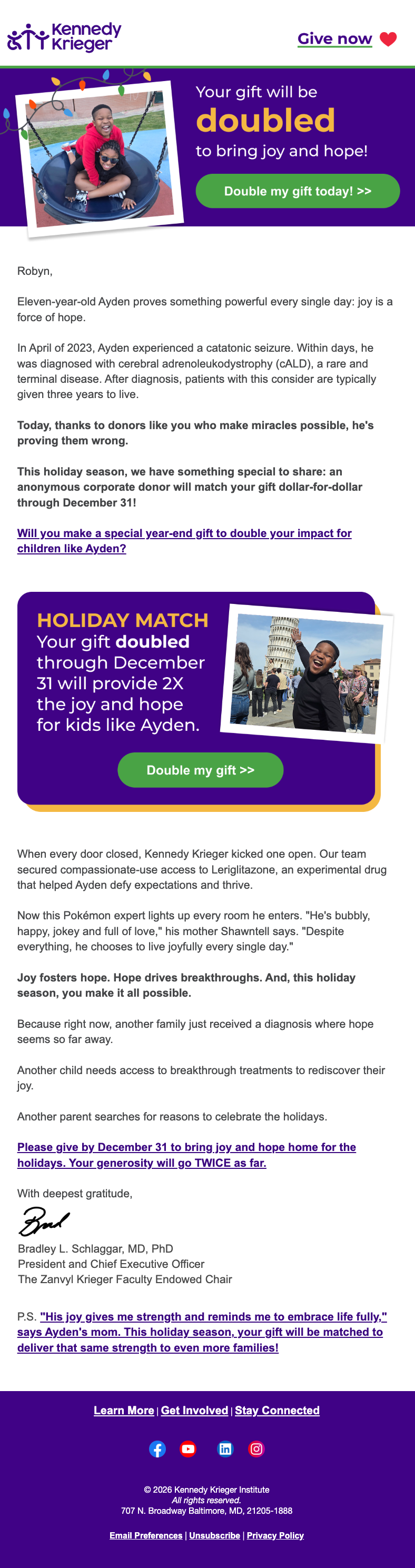
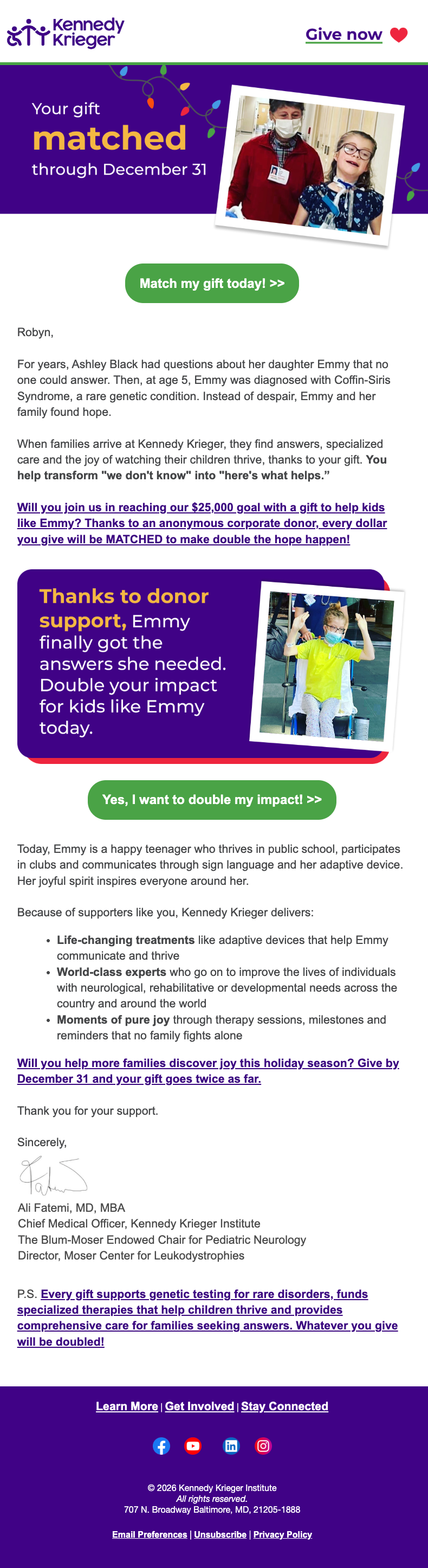
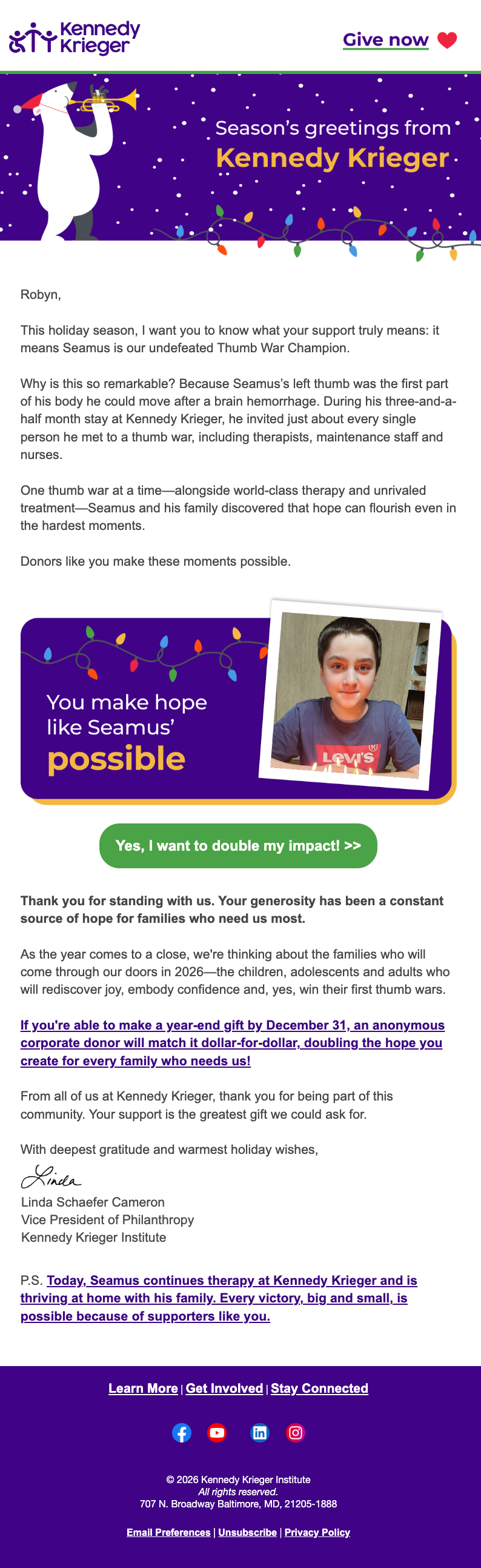
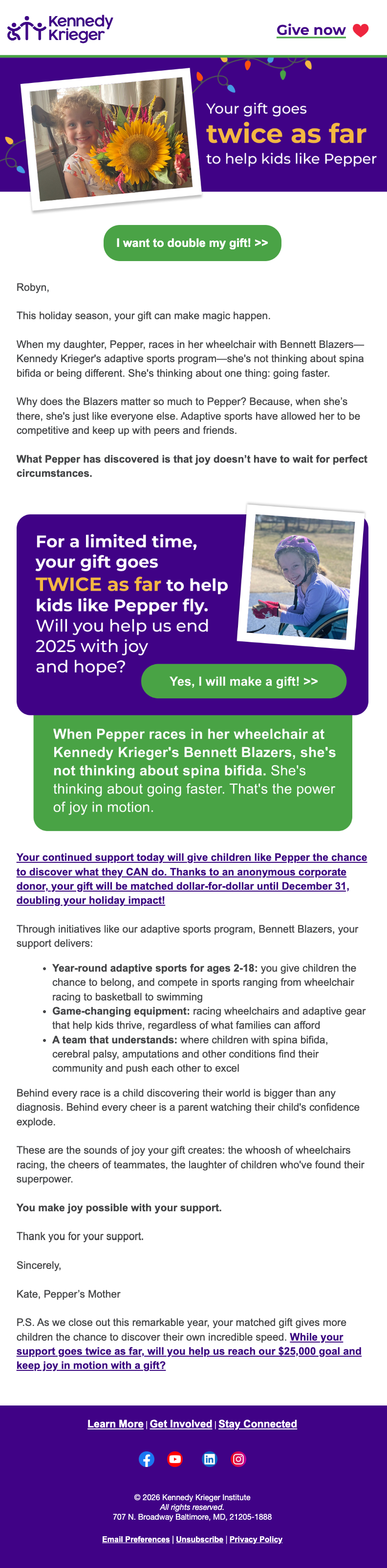
Two drops. Two children.
One emotional throughline.
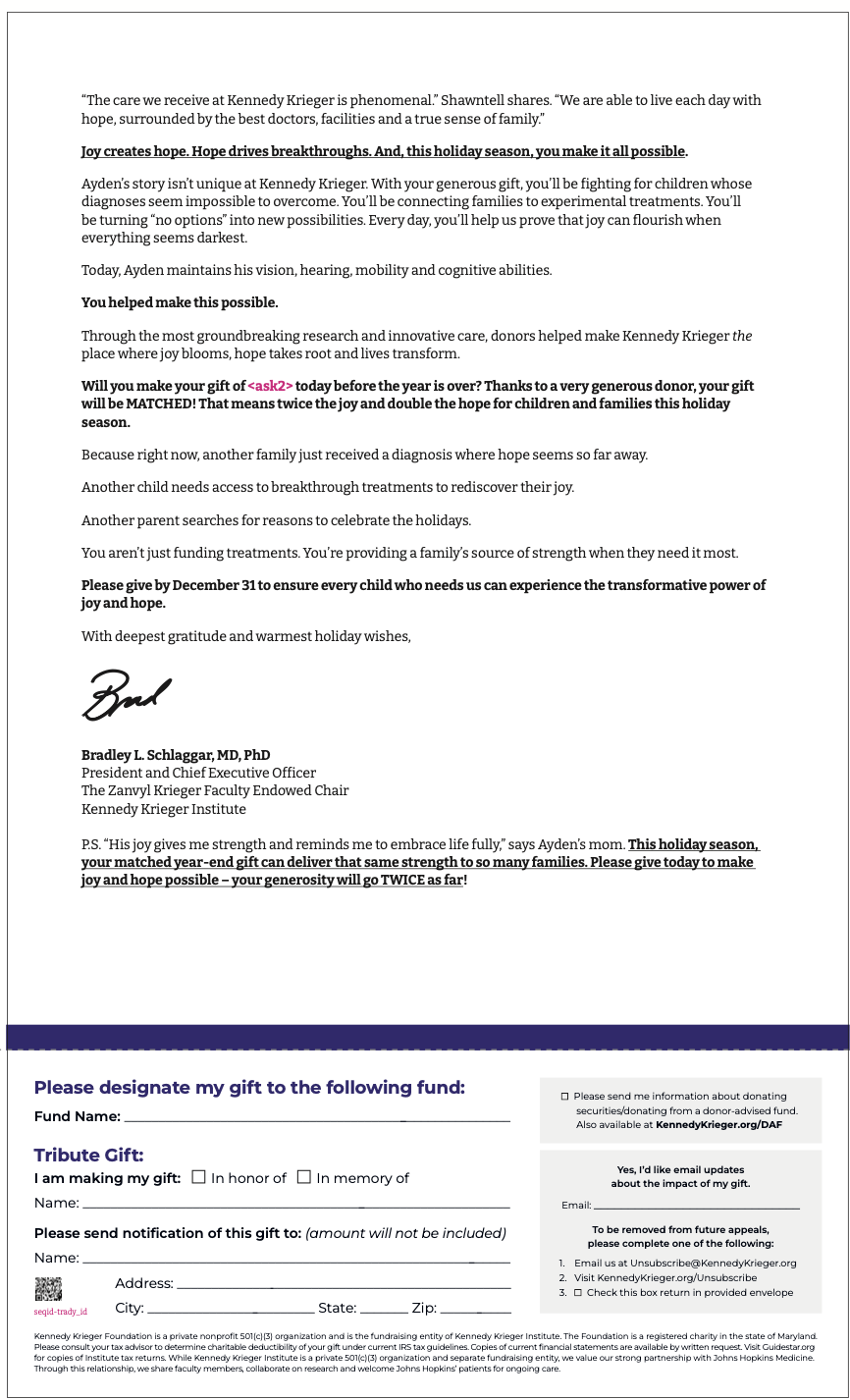
The direct mail program ran alongside the email series — two drops, each built around a different patient ambassador. Each piece included a letter, reply device, outer envelope teaser, and lift note. All copy written and versioned across donor segments.

Revenue up 44%.
Patient audience responsive
across all channels.
The campaign's most significant finding: 16% of donors were net-new from the patient and family audience — people who had never given before. That's not just a revenue story. It's proof that the right message, delivered to the right person, converts someone who already believed in the mission into someone who acts on it.
The email program drove +608% revenue year over year. Giving Tuesday raised $64,726 — up 23% from the previous year, with two first-time gifts of $1,000 and two of $500.
All copy written by Alexander Filice in collaboration with the account team at Digital Health Strategies.